

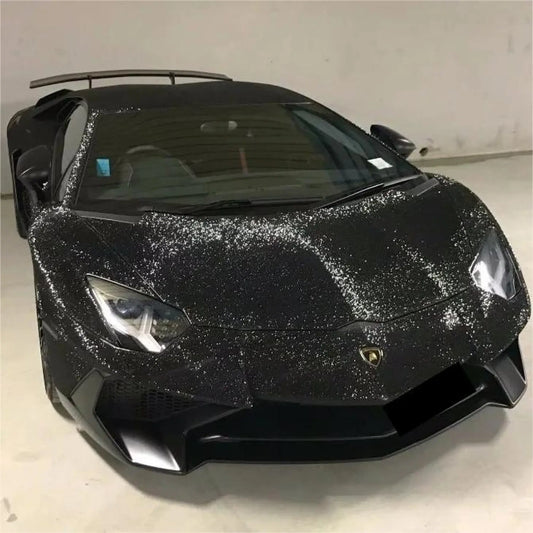
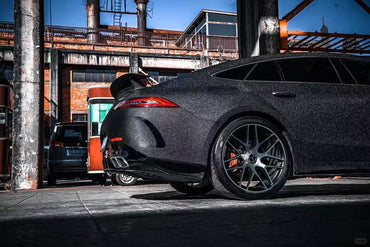
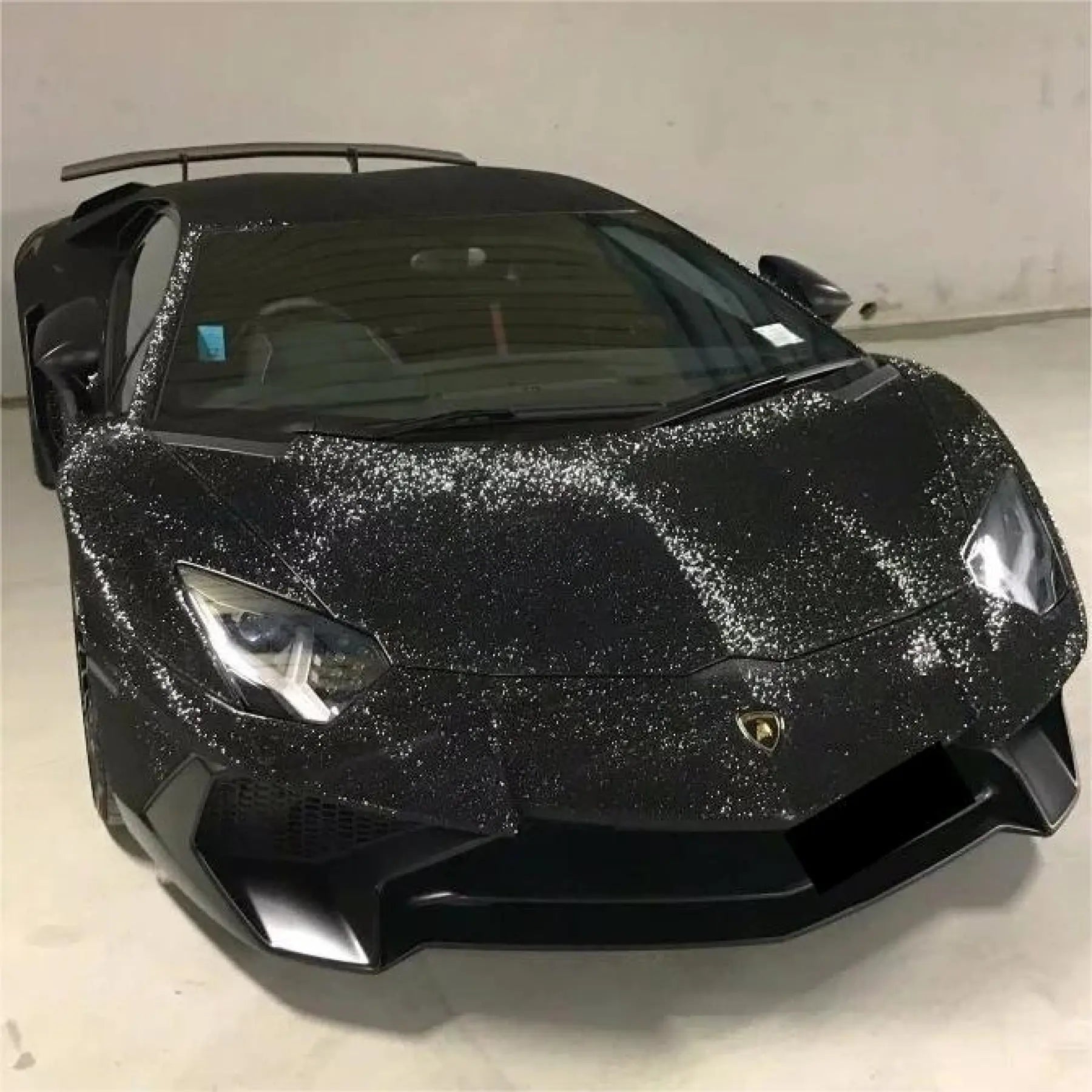





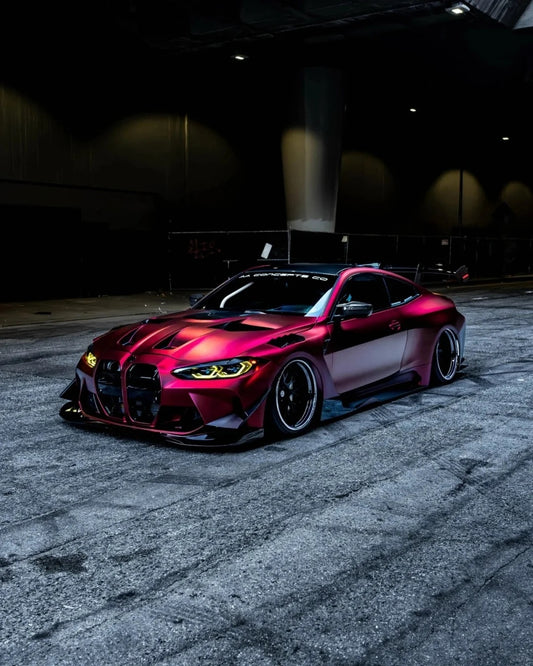




A gloss black panel forgives a lot. A glitter black panel forgives almost nothing. Same car, same installer, same afternoon — and one of them will show a speck of dust from three metres away while the other swallows it whole.
That is the whole story of sparkle film in one sentence, and it explains why installers who are completely comfortable with matte and gloss sometimes end up frustrated on their first glitter job. The material is not harder to stretch. It is harder to hide behind.
What is physically different about a glitter film
A solid colour film is a pigment layer. Light hits it, most of it scatters back in a uniform way, and the panel reads as one colour from every angle.
A glitter or sparkle film suspends reflective particles inside or beneath the colour layer. Each particle acts as a tiny mirror sitting at its own angle. When light arrives, thousands of those mirrors return it in thousands of directions, and only the ones aligned with your eye light up. Move your head and a different set fires. That is why the surface appears to move.
Two consequences follow, and both matter at installation.
Consequence one: the film reports every flaw beneath it. Those particles are point light sources. Anything that raises the film by a fraction of a millimetre — a grain of dust, a fibre, a dried polish residue — tilts the particles around it and creates a visible bright halo. On gloss film the same speck produces a small dimple that most people never notice.
Consequence two: the film has an orientation. Flake alignment is set during manufacture and runs along the roll. Two pieces cut from the same roll and applied with opposite orientation will not match in direct sunlight, even though they are physically identical film. This is the single most expensive mistake on a glitter job, and it is entirely avoidable.
The underlying mechanism is the same one behind pearlescent and metallic finishes, explained further in our article on how colour is built into a wrap film and in the general reference on iridescence.
Surface preparation is not the same job
For gloss film, a good wash and a solvent wipe is adequate preparation. For sparkle film, treat preparation as the majority of the project.
Wash, then clay the panel. Clay pulls embedded contamination that washing leaves behind — rail dust, overspray, tree sap residue — and these are exactly the particles that create halos under flake film. Panels that look clean under workshop lighting routinely come up rough under a clay bar.
Follow with a dedicated degrease using isopropyl alcohol diluted appropriately, wiped in one direction with a fresh lint-free cloth and changed frequently. A cloth that has already collected residue redistributes it.
Then leave the panel alone. Every additional touch after the final wipe is an opportunity to deposit a fingerprint oil that will show once the flake sits over it.
Airborne dust is the other half of the problem. A sparkle install wants still air, a wetted or swept floor, and no fans blowing across the work. If the workshop has just had another vehicle sanded or cut in it, wait.
Heat control: less than you think, more evenly than you think
Sparkle films tolerate heat well but punish uneven heat.
The particles do not stretch. The polymer around them does. When a section is overheated locally, the polymer thins around particles that stay the same size, and the flake density in that zone visibly drops. The panel ends up with a dull patch that no amount of post-heating restores, because the particles have physically spread further apart.
Practical rules that hold across the range:
Work in wider passes at lower temperature rather than concentrated blasts. Keep the heat gun moving continuously and further from the surface than you would for a matte film. Take stretch out of larger areas rather than pulling hard in one spot. Where a deep recess demands genuine stretch, stage it across several gentle cycles instead of one aggressive one — technique covered in our guide to wrapping deep recesses without lifting.
Ambient temperature matters as much as gun temperature. A cold panel takes the heat unevenly no matter how carefully the gun is handled, which is the underlying point of our article on minimum installation temperature.
Plan flake direction before the first cut
This is the step that separates a professional glitter job from an expensive one.
Decide a single direction for the entire vehicle before cutting anything — conventionally with the roll running front to back along the car. Mark that direction on the backing paper of every piece as you cut it, with an arrow. Then apply every panel with the arrows pointing the same way.
Doors are where mismatches usually appear, because it is tempting to rotate a piece to get better yield from the roll. The material saved is not worth a door that reads a shade darker than the wing beside it every sunny afternoon.
Bonnets and roofs are the second risk area, because their orientation relative to the light is different from vertical panels anyway. Keeping the flake direction consistent means the difference you see between horizontal and vertical surfaces is the natural one, not one you introduced.
Buy from a single roll where the vehicle allows it. Where a project needs two rolls, place them on panels that are not adjacent, and view both in daylight before committing. A dedicated deep-dive on panel matching is planned at glitter wrap colour matching between panels.
Squeegee and edge technique
Use a felt-edged squeegee, and replace the felt more often than usual. Sparkle films have a slightly firmer surface and the felt collects grit faster; a contaminated squeegee drags that grit across a panel that shows everything.
Overlap passes generously and work from the centre out. Where two squeegee paths meet on a solid colour, the joint is invisible. On flake film, a missed strip leaves a fractionally different light return that catches the eye at a low angle.
Edges and tucks behave normally, but inspect them under a torch rather than overhead light. A microscopic lift at an edge is far more visible on sparkle film once sunlight reaches it, because the raised flake angle changes.
The wrapping tools range covers the squeegees, blades and knifeless tape suited to this work, and the DIY installation guide covers the fundamentals that apply to every film.
Which sparkle finish suits which build
Diamond Glitter Black is the highest-contrast option in the catalogue. It reads as a deep, near-solid black in shade and erupts into fine white sparkle under direct sun or event lighting. It suits vehicles with strong body lines, because the sparkle intensity changes across a curve and draws the shape out. Browse the wider black wraps selection for pairing options.
Pearlescent Sparkle Glitter White works in the opposite direction. The base is bright, so the flake reads as depth and shimmer rather than contrast. It flatters smooth, sculpted panels — modern electric saloons and crossovers especially — where a flat white would look plain. See the full white wraps range.
For builds that want movement without full-vehicle sparkle, combine a sparkle roof or bonnet with an Ultra Matte body, or use the Rainbow Laser films for accents where a colour shift rather than a flake sparkle is wanted.
Order a swatch, and look at it outdoors
Sparkle film is the category where photographs mislead most. A camera either flattens the flake into a texture or blows it into a glare, and neither is what the eye sees.
Take a swatch from the sample kit outside. Look at it in direct sun, in open shade, and under street lighting at night. Tilt it. The behaviour across those three conditions is what you are actually buying. Advice on capturing the finish accurately for social content is planned at how to photograph a wrapped car.
Aftercare
Sparkle films are washed like any other cast film — gentle, frequent, two buckets, no abrasive polish. One specific point applies: avoid machine polishing entirely. On a solid gloss film, light polishing can revive a dull patch. On a sparkle film, polishing abrades the top layer over the flake and permanently reduces the brilliance, because the clarity of that layer is what lets the particles read.
Full washing guidance is in the film maintenance guide. Background on how these films are constructed is covered in the general overview of vehicle wrapping, and the decorative particles themselves are described in the reference on glitter.
Workshops installing sparkle finishes regularly can access trade pricing through the dealer programme.
Frequently asked questions
Are glitter wraps harder to install than gloss? The stretching is comparable. Preparation and dust control are significantly more demanding, and flake direction adds a planning step that gloss film does not have.
Why do two panels look different shades? Almost always flake orientation. Pieces applied with the roll running in opposite directions return light differently under the same sun.
Can a glitter wrap be polished if it dulls? No. Polishing removes clarity from the layer above the flake and reduces sparkle permanently. Wash correctly instead.
Do sparkle films last as long as solid colours? Yes, under the same conditions. Ultraviolet exposure, heat cycling and washing discipline drive lifespan far more than the presence of flake.
