



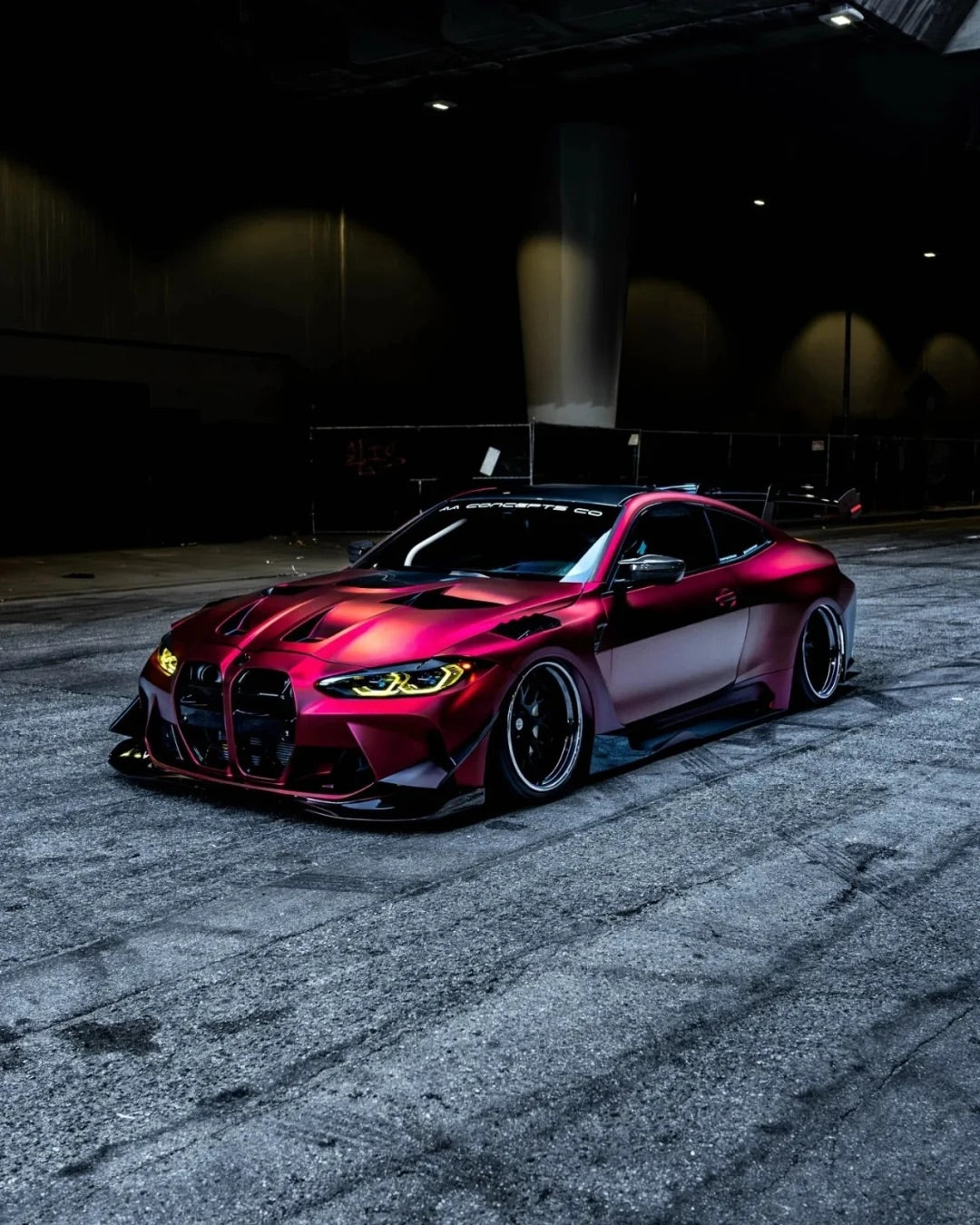


Metallic: flake suspended in the colour
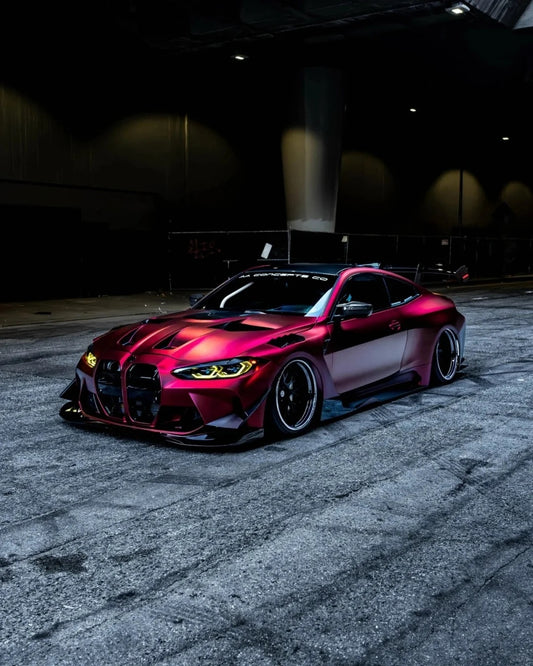
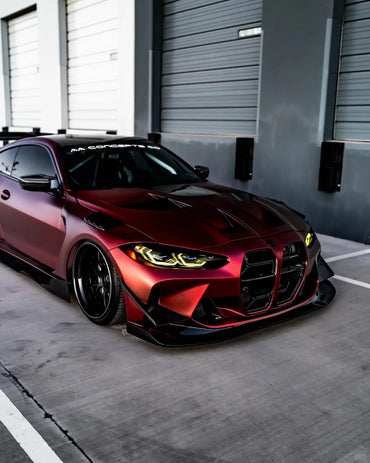
Metallic films add microscopic aluminium flake into the pigment layer. Those flakes act as thousands of tiny mirrors lying roughly parallel to the panel surface. Where light hits them straight on, they throw it back hard and the panel goes bright. Where light strikes at a shallow angle, the flakes return far less and the panel drops toward its base tone. That bright-to-dark swing across a curve is called flip, and it is what makes metallic finishes read as expensive.
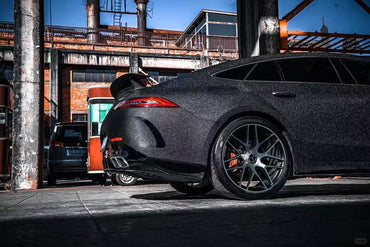
Flake size is the variable that changes character. The Metallic Series runs 22 colours with a medium flake that gives visible sparkle without coarseness, seen in finishes like Metallic Gloss GT Silver and the darker Ghost Midnight Purple.
Push the flake finer and denser and individual sparkle disappears into a continuous poured-metal surface. That is the Liquid Series, 36 colours strong, where Liquid Gloss Metallic Liquid Silver behaves less like a painted panel and more like mercury following the body line.
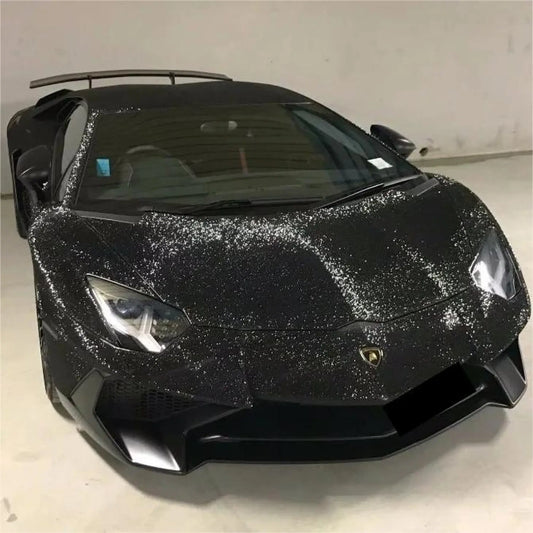
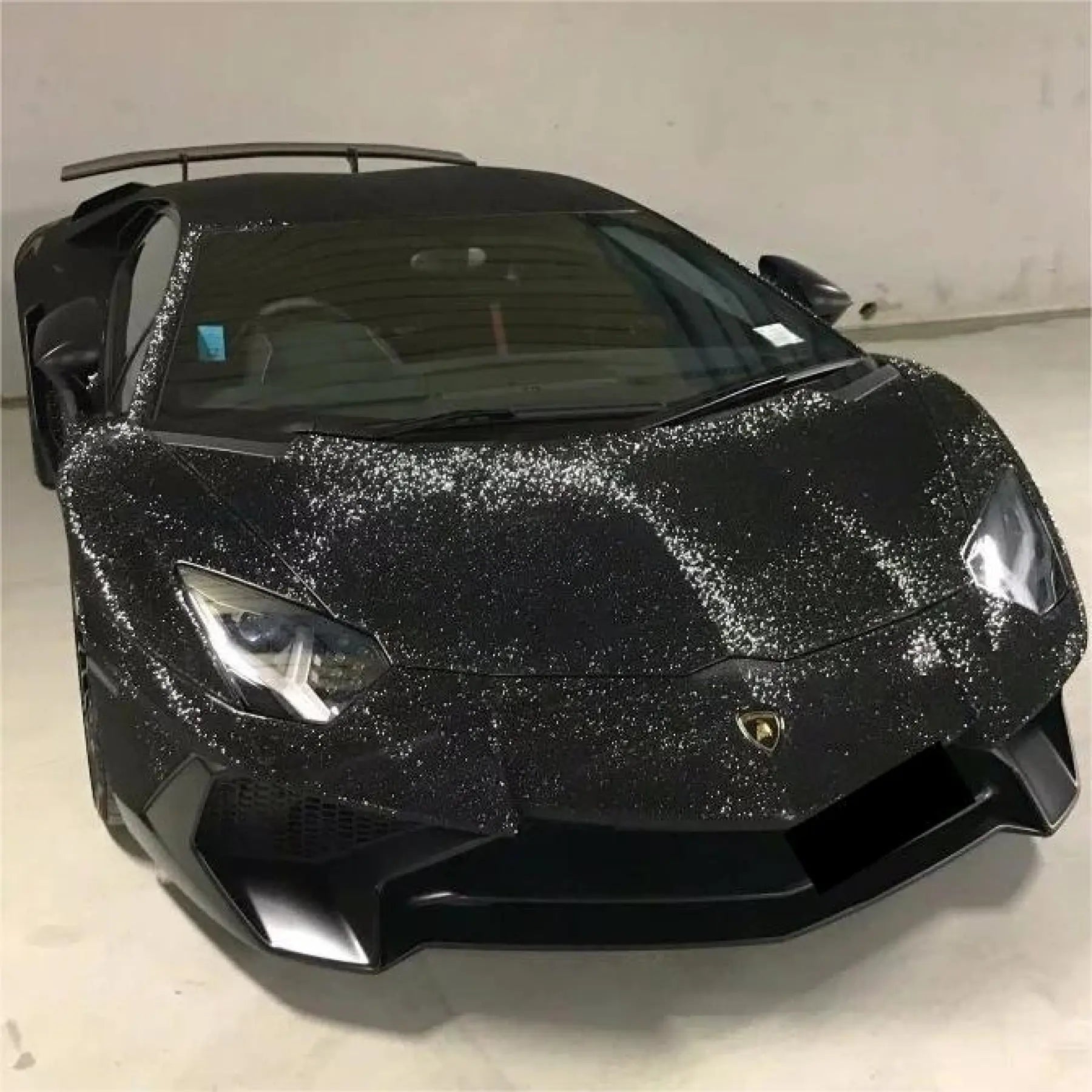
Go the opposite direction, coarse and separated, and you get deliberate glitter. Diamond Glitter Black uses large reflective particles that fire as distinct points of light rather than a smooth sheen, which is why it holds attention at close range in a way flat black never does.
The one metallic install rule that matters
Flake density controls apparent brightness, and stretching thins that density. Over-stretch a metallic panel around a mirror housing or a bumper corner and the flake spreads further apart, so the finished piece reads slightly lighter and duller than the panel next to it. Work with heat and controlled tension rather than pull, and keep an entire vehicle on one production batch. The technique detail sits in our DIY car wrap installation guide.
Pearl: interference rather than reflection
Pearl is the system most people misname. It is not a finer metallic. Pearl films replace metal flake with transparent platelets, typically mica or synthetic ceramic, coated in ultra-thin layers of metal oxide. Light does not simply bounce. Part of it reflects off the outer coating and part passes through and reflects off the underside, and the two returning waves interfere with each other.
That process, thin-film interference, cancels some wavelengths and amplifies others depending on your viewing angle. It is the same physics behind a soap bubble or the inside of a shell, and it produces a soft, lit-from-within glow instead of a hard sparkle. The result is genuine iridescence: a face colour when you look straight on, and a different travel colour at the edges.
The Pearlescent Sparkle Glitter White shows the effect at its most refined, adding luminous depth to a white body without shouting. Pushed to full strength, interference stops being subtle: the Rainbow Laser Series runs 13 colours where finishes like Laser Light Pink sweep through a visible spectrum as the angle changes. The Dual Color Dream Series takes the same principle and engineers a deliberate two-tone flip, which we cover in depth in angle, lighting and how to sell the effect.
Comparison: how the three systems behave
| Property | Pigment | Metallic | Pearl |
|---|---|---|---|
| Optical mechanism | Wavelength absorption | Specular flake reflection | Thin-film interference |
| Colour at different angles | Constant | Light to dark shift | Hue shift, face vs travel |
| Sailifilm series | Crystal, Ultra Matte | Metallic, Liquid | Rainbow Laser, Dual Color Dream |
| Photographs best in | Any light | Direct sun, hard light | Soft or moving light |
| Panel matching | Easy | Batch and stretch sensitive | Angle and direction sensitive |
| Install difficulty | Low | Medium | Medium to high |
| Best use | Full body, first builds | Full body, statement colour | Full body show cars, accents |
Read this as a menu, not a ranking. Pigment buys reliability, metallic buys drama under sun, pearl buys movement that exists only when the car or the viewer is moving.
What each system demands during installation
Pigment films are the most tolerant. There is no orientation and no angle penalty, so cuts and joins are judged purely on placement.
Metallic films demand consistent tension, because stretch dilutes flake and the visible risk is a lighter panel beside a darker one, most often on recessed sections and complex bumpers.
Pearl films demand consistent direction. Interference travel is tied to how the platelets sit, so panels applied with opposing orientation can show mismatched flip on one side of the car. Plan the whole flank as a single map before the first cut, then check the result from two angles under two light sources. Stock the right wrapping tools before starting rather than improvising mid-install.
Choosing the right system for your build
For a daily driver where consistency matters and you want a clean factory-plus look, choose Crystal gloss or Ultra Matte in a strong pigment colour. Browse by tone through black wraps, white wraps or silver wraps.
For a car with sculpted body lines that deserve emphasis, metallic is the right answer, since flip is what makes a crease visible. A Metallic or Liquid body reads as a factory premium option rather than an aftermarket restyle.
For show cars, content builds, and anything that lives on camera, pearl and interference finishes win outright because they produce a different frame every few degrees of rotation. Many of the strongest builds combine systems: a pigment or metallic body with pearl accents, or a 3D carbon fiber hood against a solid body. Budget and complexity planning for those combinations is covered in matching film series to vehicle complexity and budget.
Whichever system you pick, judge it physically. Screens compress exactly the angular information that metallic and pearl films exist to deliver, so a pearl looks like flat pastel and a liquid metallic looks like grey on a monitor. A sample kit at $29 with buy one get two free lets you tilt the real film against your own paint in daylight before committing to full rolls.
Care differences between the three
All three systems sit under the same UV-stable topcoat and want the same treatment: hand washing, pH-neutral soap, soft media, no abrasive brushes, and prompt removal of bird droppings and fuel splash. Full detail is in the car film maintenance guide.
One practical difference is worth knowing. Metallic and pearl surfaces hide light swirls better than solid gloss because their broken optical structure disrupts the eye's reading of fine scratches, while a deep solid gloss shows every wash mark. Against that, a damaged pearl panel is harder to replace invisibly than a damaged pigment panel. When the wrap eventually comes off, all three release the same way, as explained in protecting the original paint during removal.
Frequently asked questions
What is the difference between metallic and pearl car wrap?
Metallic film uses aluminium flake that reflects light directly, producing sparkle and a light-to-dark shift across curves. Pearl film uses coated mica or ceramic platelets that split light through thin-film interference, producing a soft glow and a hue shift rather than a brightness shift. Metallic is bolder in direct sun; pearl is more refined and changes colour rather than intensity.
Which finish is easiest for a first-time installer?
Solid pigment films from the Crystal Series or Ultra Matte Series. They have no directional behaviour and no stretch-related colour shift, so a small error in panel orientation or tension will not show up as a visible mismatch. Metallic and pearl both punish inconsistent handling.
Does stretching a metallic wrap change its colour?
Yes, slightly. Stretching spreads the suspended flake further apart, which reduces reflective density and makes the panel read a shade lighter and flatter. Use heat and controlled tension instead of hard pulling, and keep a full vehicle on one production batch so any variation stays consistent.
Do pearl wraps look different in photos than in person?
Almost always. Pearl and interference finishes depend on your viewing angle, and a photograph fixes one angle permanently, so the travel colour that makes the film interesting disappears. Always evaluate pearl film in hand, tilted under real daylight, before ordering a full roll.
Which system lasts longest?
Durability is set by the vinyl body and the topcoat, not by the colour system. Sailifilm films are built on high-grade polymeric vinyl rated three to five years with proper care, regardless of whether the colour layer is pigment, metallic or pearl. Washing habits and sun exposure matter far more than finish type.
Can I mix pigment, metallic and pearl on one car?
Yes, and it usually looks better than a single system. A common approach is a solid or metallic body with pearl or interference accents on the roof, hood, or mirror caps. Contrast between optical systems creates visible separation between panels, which is what stops a one-colour build from looking flat.
Next step
Decide the behaviour first and the colour second. Ask whether you want a surface that holds one colour reliably, one that flares and darkens with the light, or one that changes hue as you move around it. That single decision narrows 150-plus Sailifilm colours down to one series, and the shade choice inside that series becomes easy. Order a sample kit, tilt the swatches against your own paint in daylight, and confirm the behaviour before you buy metres.
Background reading: Pigment · Metallic paint · Thin-film interference · Iridescence · Mica · Vehicle vinyl wrap

